

The wine business needs to wake up.
There’s such a ludicrous delusion in the wine world of what the fuck is going on with human beings. Period. It’s to the point where, and this is why I’m posting wine content right now, me giving 0.01% effort can have a bigger impact than 99% of what’s going on in marketing in the wine world.
I was talking with my team about this. One of them worked for years picking grapes in Sonoma County, in the Russian River area, and told me what growers are saying now that harvest is wrapping up. They can’t sell their grapes. California wine sales are down more than 20% over five years. Prices are dropping. Families are deciding whether to replace vineyards with crops that are in greater demand. It’s dire.
A relevance problem
In the wine world generally, we have a complete lack of social media understanding. There’s a complete lack of streaming understanding, and there’s a complete lack of podcast understanding. We also have a complete lack of Gen Z and millennial interests. Just a complete lack of relevance, complete detachment, and finger-pointing that the industry’s decline is all about drinking and health trends. No, it’s not.
I know the drinking numbers are down. I know alcohol’s down because of cannabis, because of health and wellness, maybe other reasons. It’s still a massive industry. The amount of alcohol that will be consumed in America today is astonishing: Americans will drink something like 400 million drinks today alone. We spent $228 billion on alcohol in stores last year, about as much as we spent on movies, books, music, and video games — put together. And that’s before a single bar tab!
So, it’s less about “people aren’t drinking anymore.” What we have is a fundamental relevance issue in the wine world. Consider that spirits have overtaken wine in global consumption volumes for the first time since records began in 1990, according to new data from IWS.
There’s no one, let alone multiple people or organizations, committing to very contemporary marketing. And they look around and ask, “What’s wrong?” Luckily, there are a couple of Substackers (including Jason Wilson’s “Everyday Drinking”) writing good content, but that’s for the nerds.
So, I asked my team: when’s the last time you saw a piece of wine content from a company that made you stop, think, and care? Nothing.
I’m so sad and so tired of the complete delusion, attachment, and lack of accountability. The industry ate itself from within thanks to douchery, elitism, and ideology. I came along in 2006 trying to do something contemporary, and they all, you know…there are a lot of delusional snobs in the wine world.
So they’re getting what they deserve. And it’s going to get worse.
Growers don’t get a pass
Growers are a different animal altogether. They’re just at the mercy of supply and demand. But again, there have been single vineyards that have built up a brand through the years.
I love a lot of those farmers, and I struggle with razzing farmers because I have this elevated respect for it. But I can’t give them a pass. They’re not building up their brand, either. And by the way, they were thrilled when times were good.
Times are bad. The wineries you sell to are bad at marketing, or not consumer-centric. They do not realize it’s 2026. What do you want from me? I keep hearing growers say, “I need to be on social media. I just don’t know what to do.”
That’s a fucking excuse. That’s like saying, “I want to be strong and have muscles. I don’t know what to do.” Yes, you do.
Here you go, wineries
In an AI world, I literally opened Claude in the middle of a recent conversation with my team. Every one of you should do this. Here’s what I told it:
I’m a grape grower in Santa Barbara. I make Chardonnay and Pinot Noir. The wine industry is shitting the bed. I need to get more demand. I think I’ve got to start branding my vineyard, kind of like To Kalon branded their vineyard up in Napa Valley. I’ve got to get people to know my family’s vineyard. We’re a single vineyard. I want to be able to sell my grapes so that wineries put my single vineyard on the label because people are demanding it, because I figured out how to do social media. What are the first seven steps I need to take to build up social media so that my family’s vineyard gets branded, like To Kalon, like Hyde, and people want to buy my wine?
That’s it. I’m so sick and tired of “I don’t know what to do.” There it is. Here it comes. No more excuses.
Here’s what came back from Claude (I simplified it for this article):
Make the real goal: winemakers fighting to put your vineyard’s name on the label.
Pick one sharp story.
Lock up your name. Grab the handle on every platform.
Don’t talk about the weather or the climate; make the family the show.
Write the vineyard name into your contracts, and promote the winemakers who buy from you.
Win over sommeliers and retailers by writing to them directly.
Build an audience of your own. Do a small house bottling, even a few hundred cases, sell it direct, and start an email and text list.
Then show up daily and commit for years.
The 2026 version of Wine Library TV
Then I asked a follow-up:
Gary Vaynerchuk did Wine Library TV back in 2006 on YouTube. Is that something I can replicate today? What would be the 2026 version of it?
This is a masterclass, what I’m doing right now, and it’s f*cking mundane. This is level zero for how I think about marketing.
The Claude answer: you can’t copy the format, but you can copy the strategy. Wine Library TV worked in 2006 because YouTube attention was cheap and empty, wine talk was stuffy, and I showed up every day with real personality for years. Those ingredients still work. A 20-minute webcam tasting show doesn’t.
Attention lives in short vertical video now, and in feeds. You’re competing with everyone, not just wine content, and the algorithm surfaces the best content. So the 2026 version looks like this:
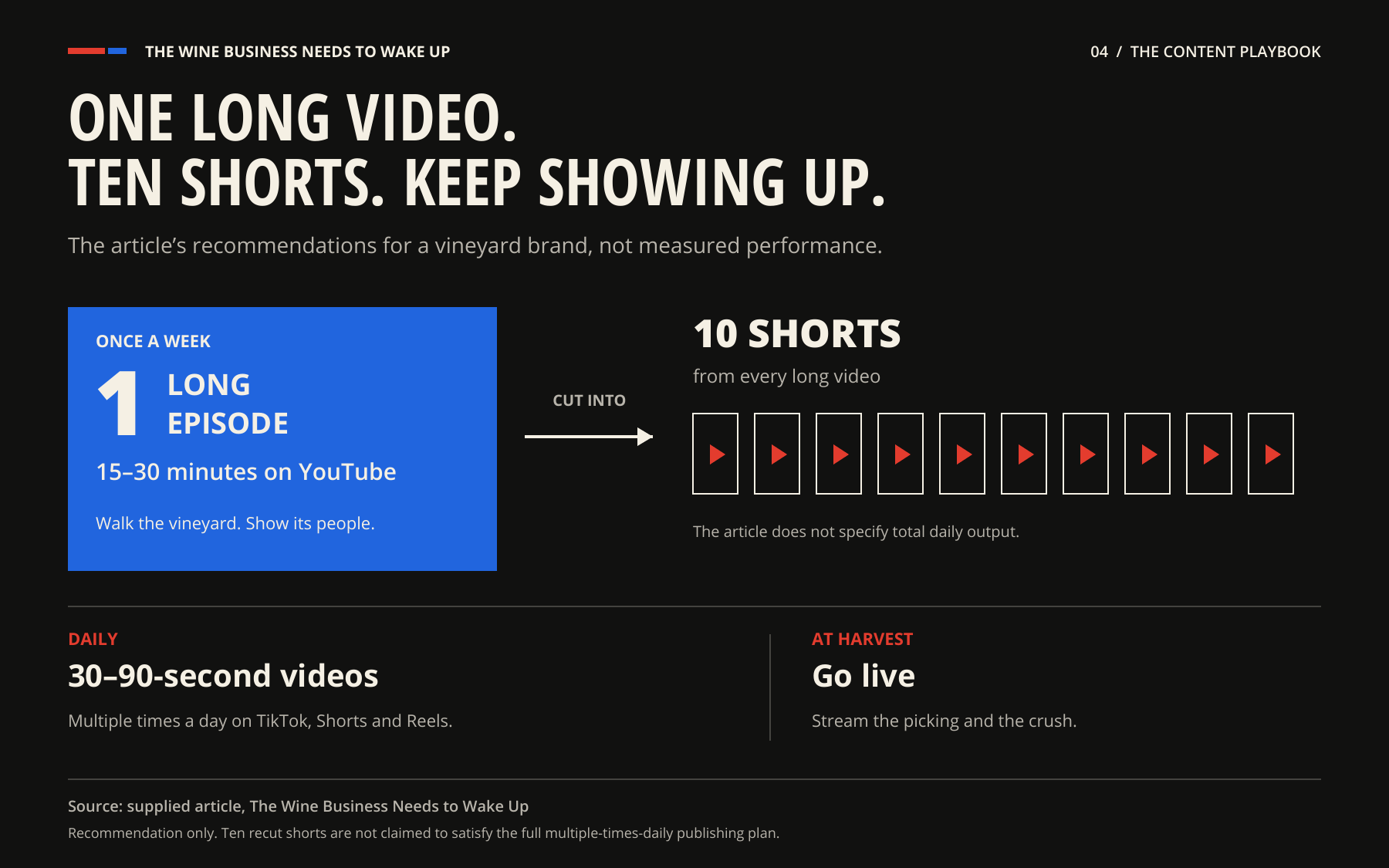
Short-form every day. Post 30-to-90-second videos on TikTok, Shorts, and Reels, multiple times a day.
One long episode a week. Put 15 to 30 minutes on YouTube, walking the vineyard. That’s the closest thing to Wine Library TV.
Go live at harvest. Stream the picking and the crush. Nobody else is showing this, and it builds drama.
Cut every long video into 10 shorts.
Bring your personality. My edge was that I was me, saying what nobody else would. Yours is that you’re a farmer. Be honest. Talk about it when the vintage is poor or challenging.
One caveat. Wine Library TV sold wine for a retail store with thousands of SKUs to move. A grower is selling one vineyard, so every episode needs to come back to why this site is special, these grapes are special, and the people involved are special. Otherwise, you’re just building a wine personality, not a vineyard brand.
These are important, important, important things.
Bleak and fixable
This is a critical moment for the industry. Wineries need to step up and refocus and understand that they need to be consumer-centric and produce creative social media assets at scale. That’s social at scale on platforms including Substack and LinkedIn. Influencers at scale, too. They need to rethink all of it.
No one gives a crap about your yields or your sugar levels. People need stories. People need contemporary references. People care about pop culture. And many of them are young: Millennials are now the largest group of wine drinkers in America, and Gen Z’s share is growing, according to The Wine Market Council (WMC). The young customers are there.
Some wineries should be giving up some of their equity, too. If I’m a winery, I’m emailing and saying, “Gary, I’m giving you 20% of our vineyard. You can own it. You just need to come in and save us.” It’s that dire. There are startups giving 5% to famous people and influencers. Wineries should be doing that.
They’re in deep shit, guys. Just so you know, they’re in deep shit. My buying team was just in California. It’s never been like this in my 30, 40 years in the business. Many of the best wines in the world — the best wines in California — have soft demand. Prices are about to collapse.
People aren’t buying California wine the way they used to, and that’s with tariffs. Can you imagine when those go away? If they go away?
The wine industry is walking right down a path that looks like stamp collecting. People are going to talk about how their grandfather drank wine back in the day. It might come back in 60 years as a retro throwback, because wine will always be around. Wine first became a thing around 6000 BCE, about 8,000 years ago, in what’s now Georgia. So it’s been around and it’s not going anywhere. But the next decade looks bleak.
It couldn’t be more bleak. On the bright side, it couldn’t be more fixable. But they’ve got to get out of the 1996 mentality. They’re holding onto a dream.
Couldn't agree more.
So agree with you on this. Love your voice on this too. I just wrote about it myself. About 3 years ago we saw the writing on the wall and started to market to the younger demo, focus on experiences, connection to land and each other and make wine fun. @foldedhills https://foldedhillswinery.substack.com/p/the-wine-business-as-we-knew-it-is?r=48xcr7&utm_campaign=post-expanded-share&utm_medium=post%20viewer